
An elastomeric acrylic copolymer resin based, water-based, single-component, ready-to-use, elastic white brush-applied waterproofing material that can be easily applied on any substrate.
Areas of Use : It can be used indoors and outdoors, on horizontal and vertical surfaces, on flat and sloping roofs, terraces, balconies, pools, water tanks, gutters, eaves and chimney edges, and on surfaces such as concrete, plaster, brick, zinc, galvanized metal and breeze block.
Product Features : Ready to use.
It is very easy to apply and has a semi-fluid consistency, so it can easily cover even the most difficult surfaces.
Labor cost is low.
It is elastic. At a thickness of 1-1.5 mm, it shows 600% elongation after 24 hours at 23 C.
It provides excellent adhesion to all kinds of building materials.
It maintains its elasticity under hot and cold temperature changes.
It allows surfaces to breathe.
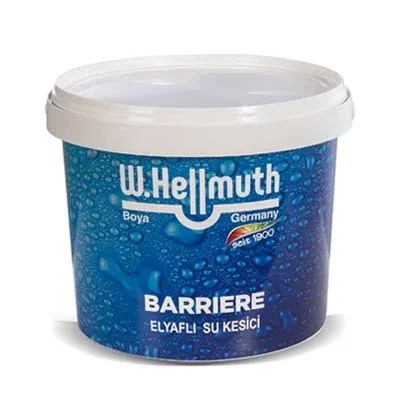
Barriere fiber-reinforced waterproofing coating must be applied on dry, moisture-free and clean surfaces.
Any oil, dirt, dust and loose substrate that would prevent the product from adhering must be removed from the surface to be coated.
It is recommended to clean plaster and concrete surfaces with warm soapy water before application. The surfaces to be coated must have a slope (min. 5%) that prevents water from pooling.
Voids and pits in the substrate must be filled with repair mortar. Depending on the condition of the surface, a primer coat should first be applied by diluting the Barriere fiber-reinforced waterproofing coating with 100% water, followed by 2 coats without dilution. (Application must be made in at least 2 coats.)
The 2nd coat must be applied at a 90-degree angle to the 1st coat. At horizontal and vertical joints, the fiber-reinforced Barriere waterproofing coating must be applied in strips.
Barriere waterproofing coating should be applied especially in dry weather between +5 C and +30 C.
Do not apply in weather conditions such as rain, snow and frost. Applied surfaces must be protected from these weather conditions for at least 24 hours.